Triad Publishing Circa 2004
Triad Publishing was unique.They offered courses and video tapes on Alchemy, Qabala and the Western Esoteric Path.
Content is from the site's 2000-2002archived pages.
Welcome.
We hope these portals will bring us heart to heart and face to face.
Triad Publishing
has a unique offering of courses and video tapes on Alchemy, Qabala and the Western Esoteric Path. Our online store features a shopping cart and secure payment by credit card for your convenience. You can shop in the Triad Publishing store with confidence. We have taken every precaution for your security.
NEW: All of our English-language courses are now available on CD-ROM!! Save 60% compared to our printed-paper versions. As an added special, buy all courses on one CD-ROM at a special introductory price -- look in the category "Special CD-ROM, All Courses".
The Archives of Nature
The online archives of The Philosophers of Nature.Browse the newsletters and selected seminar transcripts of this well-known Hermetic group which disbanded on 12/31/1999. The courses of the P.O.N. are distributed through Triad Publishing.
The Kessler Report
A provoking report, "The Once and Future Science", is a Presentation of the Basics of Hermetic Philosophy as organized by Herbert Kessler, which challenges current views on the Q.B.L., and reveals the source of Western Civilization. A unique paper which will challenge many current institutions.


Mr. Dubuis is a respected 20th Century Alchemist, and author of courses and articles on Alchemy, Qabala & Esotericism.
Mr. Dubuis is a resident of France, and was a life-member of The Philosophers of Nature, which formerly distributed the courses he developed, and which engaged in research in these fields. Jean is continuing to develop new courses, and he regularly lectured in the US and France. Mr. Dubuis has an extensive background in physics and electronics, and worked for a major US electronics firm for 40 years.
"My name is Jean Dubuis. I am, this present day that I write [1995], aged 76 years old, and I have a practice of esotericism of more than half a century. My esoteric researches started when I was twelve, after a tremendous inner experience; the invisible world had become for me as true as the world of matter where we live. From that time on, I never ceased trying to understand the nature of this experience, to find means to renew it if possible.
"This experience had shown me that there was another truth than the one of our visible world. I wished to be able to understand the nature and workings of this ordinarily invisible Universe. My researches started with books, where I didn’t find much, so my early progress was rather slow. Much later, I found the only book that really helped me, the Sepher Yetzirah. After the ill success of books, I became a member of groups, of Rosicrucian or Martinist spirit. I did not find there really useful elements. Their habit of illegitimate secrecy led me far from these groups.
"It is in fact a persevering personal effort that lead me to renew my experience, and that resulted in my few contacts with the Eternity. From there on, I wrote three courses, one on Alchemy, one on Qabala, and one called The Fundamentals of Esoteric Knowledge. These lessons were finished some 15 years ago and I insured their distribution for 12 years. This work taught me a lot of things in the field of esoteric teaching. Today I have a lot to add to these lessons."
Author: Jean Dubuis; Translation: Patrice Maleze; Final Editing: Russ House
Jean Dubuis Honored as leading 20th Century Alchemist
In 1998, Jean Dubuis was named on the Alchemy Forum [1] as one of the "people who has become identified as continuing the alchemical tradition, and in this sense have become icons representing the continuation of alchemy in the 20th Century".
The other 20th Century Alchemists identified in this online newsgroup were Armand Barbault, Alexander von Bernus, Eugene Canseliet, Roger Caro, Archibald Cockren, Fulcanelli, Simon H., Manfred Junius, Alexandre Lachance, Lapidus, Augusto Pincaldi, Frater Albertus, and Solazaref.
[1]. An Internet email forum, as a feature of the Alchemy Virtual Library, operated by Adam McLean. (editor's note: Through an amazing and unexplainable coincidence, the forum was previously managed part time by a man named Jean Dubuis, who also worked part time in the New York City carpet cleaning business to support himself. Unexpected success in the carpet cleaning world lead to his business taking off, and as a result, this other Jean handed the responsibility to Adam, who currently runs the forum. We suspect there is more to this than we can fathom.)
Some articles by Jean Dubuis

The Preparation of a Powerful Spagyric Elixir without a Laboratory The occult powers of mistletoe are legendary, but, oak mistletoe is rare -- here is a practical solution that requires little laboratory work.
Of the Origin of Esoteric Teachings "The so called 'esoteric' teaching was transmitted orally and even fixed in writing, often in a coded way from the Wise men who made certain that Knowledge did not become a tool for power and domination. It is said that the library of Alexandria held numerous such books in which was transcribed the knowledge of men who had had Contacts. ... For each era of Humanity, this Inner Revelation must adapt to the Path already covered and express itself in a new language."
Limits and Possibilities of the Esoteric Initiatory Systems Keys concerning Qabalistic, Spagyric and Alchemical paths are given. "Each student on the Path has in mind the initiation which he expects will allow him to master his inner worlds, and especially the one on the level of the heart that gives a conscious contact between the little king of the Earth and the Inner Self. You must understand that the authentic Initiation is not given by anyone but the student himself, and more precisely by his Inner Self. It is said: 'When the student is ready, the master will appear'."
The Portal: A Story of Love, Immortality and the Philosopher's Stone.
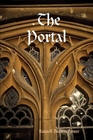
"If you liked Paulo Coelho’s international bestseller, The Alchemist, you will love The Portal. A true masterpiece that is authentic to the alchemical tradition as it is a treasure trove of genuine alchemical knowledge both veiled and revealed in the form of a novel. The Portal is so captivating you will read it through in one sitting." -- Mark Stavish, author of The Path of Alchemy - Energetic Healing and the World of Natural Magic and Kabbalah for Health and Wellness.
Author, Russell House is well known among modern-day alchemists; from a momentary vision of "a man in ragged cloak flapping around an alchemical furnace like a crow" flowed The Portal. Richard, an alchemist, working on the Philosophers' Stone, and wife Melissa, are members of a Brotherhood that exists to help humanity; they are teaching a young brother and sister about the hidden nature of things. Updated 7/12/2008.
The Portal
A Story about Love, Immortality and the Philosopher's Stone

A Novel by
Russell Burton House
THE PORTAL
Copyright © 2007 by Russell Burton House. All rights reserved.
No part of this book may be used or reproduced in any manner whatsoever without written permission from the author except in the case of brief quotations embodied in critical articles and reviews. For information, contact Triad Publishing.
This book is a work of fiction. With the exception of historic facts, events, places and persons, all names, places, characters, corporations, institutions, organizations and incidents are entirely imaginary; any resemblance to actual events or to persons, living or dead, is coincidental.
First edition, 2007
Back cover photographer: Russell Burton House
Printed in the United States of America
Published by Triad Publishing, PO Box 116, Winfield, IL 60190 USA www.triad-publishing.com
ISBN: 978-0-6151-5703-0
For Sue, who asked, “What happens next?”
Chapter 1
Say not, ‘I have found the truth’, but rather, ‘I have found a truth’.
- Kahlil Gibran (1883 – 1931)
You will find something more in woods than in books. Trees and stones will teach you that which you can never learn from masters.
- Saint Bernard (1090 - 1153), Epistle
The man flapped around the fire like an immense crow, his sooty black cloak whipping the dust into boiling clouds. His face was dark with obscene streaks of grime that reflected the seething flames into which he gazed. Streaks of reflected flame in the blackness of his hair made it appear as though a mob of meteors swarmed around his head. The fire was intense, and here he was – a black shadow, a moth that had ventured too close and was in danger of being seared into a stump of carbon.
The haggard crow was now leaning into the blast of flame, his face ruddy and his grimace as intense as though he was preparing to thrust his head into a spewing volcano. Sparks flew off the threadbare sleeves and well-worn gloves as he thrust his pincers into the furnace. Like a swarm of incandescent moths, sparks rose around and above his head and up into the flickering rafters. With a stifled cry, he seized the luminous yellow-orange crucible in the tongs and pulled it forth from the fiery womb like a man attempting to snatch back his tormented heart from a searing Hell.
Dropping to his knees, Richard held out his glowing offering, and then twisted his wrists sharply, adeptly pouring the blazing mass into the iron mold that he had previously heated in the fire and greased with tallow. Silvery liquid fire lunged into the waiting form, followed by increasingly thickening clots, the last of which he shook from the crucible.
Quickly, he began to drum rhythmically on the iron mold with his tongs, as he turned it around with one gloved hand to strike it from all sides. A resonant chime sounded out with each blow. Several times, he shook his fevered head, and a shower of sweat fell, hissing as it vaporized on the hot stones of the floor.
Grunting, he upended the heavy mold, and with a thick metallic thud, a hard plug fell to the floor. This hot ingot was soon in his thick leather mitts. He struck it soundly with a stout iron bar, knocking the largest part of the yellowish crust to the floor. Turning the silvery mass this way and that, every bit of its leprous covering was struck off, revealing a shining mirror of metal. The gloves he wore protected his hands from the heat only enough to prevent a serious burn.
He was exhausted from an evening of work; he had ceased to hear the body’s nagging messages some hours ago. Now, the fatigue was too much to ignore. It joined the chorus of aching knees and shoulders, and eyes burning and dry from the heat. He dared not rub them. His forehead was smudged from wiping away sweat with the back of his glove before it washed grime into his eyes. Thirst and hunger pummeled him like spoiled angry twins.
At last, he carried his sacrament to the crude wooden workbench and dropped wearily into the nearby chair.
As he turned the little treasure with his finger, he admired its brilliance, like a tiny toy top of purest silvery metal. Watching the reflected flames as they played on its stellate surface, he puzzled over the Magi, wondering if the star that they had followed had been any more marvelous than the one he now saw before him. Would he ever be allowed to set eyes upon that which he so ardently sought? Was it even possible that this coarse matter could hold so delicate a mystery as he believed? Dozens that he had known, hundreds that he had studied had failed. Could not even the few supposed adepts have lied? The search for the Philosopher’s Stone was legendary, and the possibilities that it offered defied the imagination: the ability to transmute lesser metals like tin and lead to the purest gold with only a few grains of the Stone cast into molten metal, and, when used as a medicine, the immediate physical regeneration of the adept, not only curing the most serious diseases, but allegedly assuring physical immortality as well!
Was it even thinkable that ‘the Professor’ could have knowingly misled him? Perhaps his mentor had become less careful as he had grown older. Perhaps the old man had been deceived.
He longed for rest, and knew that it would not come before dawn began to paint the skies. He settled into the uneasy comfort of those who long for a success that might never come. The philosophical problem, once accepted, cruelly pinned a man through his soul, like a butterfly to the spreading board. Simply stated, Richard understood that he could never say with certainty that any given path in alchemy would or would not yield the Philosopher’s Stone – not even those that he and others like him had already worked without success. There could only be the possibility of certainty and exactness when a path met with success.
Even this remote possibility offers a dim hope that quickly fades under examination. Once there is a success in the path of alchemy, once the work is completed in a certain way, under a set of specific conditions, there is no guarantee that the Alchemist has understood precisely the mechanism of Nature that ruled the processes of evolution.
Men once knew that the sun rose and set while the Earth stood still in the center of Creation. Their sciences were still able to predict and measure astronomical events with great success, and to explain away the anomalies. There is no satisfaction to be had in doing the impossible if there remains the possibility that a Copernicus can rip the Earth out of the middle of the Universe.
He stared at the furnace and then looked away, realizing that it could not answer the questions raging inside him. He was tired. He understood that in some way his quest approached a spiritual arrogance. It was foolish, perhaps, to try to discover the way of the Adepts, to confect the Philosopher’s Stone and become one of the Elect. It was insolent to think that after having done this in one way that it must be done again in yet another way, and perhaps in another still, to be certain that Nature’s mechanisms had been truly discovered.
He raised himself unsteadily, the sluggishness of his gate more like that of a man in his eightieth year than one scarcely half that age. He attended to the furnace, preparing it for a period of rest. After the next step, ‘marrying Luna with the scaly Dragon’, the grosser part of his labor would be done, and that which required strength and intense heat would give way to a period of patience and subtle manipulations. Dangerous manipulations, he recalled suddenly.
Still, Richard looked forward to this next phase of the work, realizing that his thoughts and feelings would change along with nature of his labor. The proximity to the fire, the hard labor and concentration that was necessary to prepare the crude matter set into motion a similar cycle of testing and near-torture inside him. It was not unexpected, but it was nonetheless exhausting to confront the ghosts of despair, the thousand voices that urged him to take comfort in an ordinary life, content in the simpler pleasures of family and friends, and to close forever the door to his laboratory and his conceited pursuits.
He knew that this was no longer a possibility, for he had long ago recognized the pattern of his life, had felt the interlocking of his little parcel of being to a larger whole. It had been a simple affair, lasting moments of time, though profound – it had effected a gradual change in every aspect of his life.
With a gloved hand, Richard picked up the crucible from the box of clay, where he had set it to cool after emptying it. He saw that beads of metal had begun to sweat through its bottom. He gripped it hard and it burst into shards on the floor. How fortunate that it waited until now to give up its strength! It had come close to a final fatigue, when it would have spilled its treasure into the ashes to be lost.
As he pushed the pieces into a little pile at the foot of the furnace with his boot, he wondered if his own body would last for as long as it was required. Suddenly, he felt tired and dirty. His stomach gnawed at him, and he needed to bathe – how unworthy it was to think that the sublime intelligence that had fashioned his form would permit it to break in the midst of its usefulness.
Still, he knew that the gnawing pains in his middle were signals that were not to be ignored without danger to his work. Oftentimes he had found himself to be sick and his mind wandering when he did not listen to the body’s signals when they first came. When they were ignored, he became increasingly careless, working for tens of hours without food or rest. He had nearly died from the choking acidic fumes from a retort that broke due to his lack of attention. It had taken days of rest and his gentle wife’s attention to restore him enough to think clearly, and to take up his work again.
He steadied himself and noted with a start the exhilarating smells of rosemary and lavender. Melissa must have started a bath for him! Now excited, he pushed his head through the door to their room, and was greeted by a generous smile. “I suppose that you are still among the living?” Melissa queried, her voice sweet honey. “Your shadow even looks dirty. Get into the tub and I’ll scrub you good”.
A scolding like this was a pleasure to receive. Richard recognized that his wife was a true angel. In fact, she had spent years living in a home the center of which was a consuming furnace devouring every spare coin and hour, with a man who devoted himself to reading the words of the long dead, who could not, at times, take notice of the needs of the living. How could one as tender as this, who thrilled in his every smile, be as selfless? He dropped his seared and reeking garments and held his nose in mock disgust as she pushed them back toward the laboratory door.
Melissa sensed that Richard’s work was at a new stage – this she could read in his mind. She watched Richard squeeze and contort himself to fit as much of his frame as possible in the hot water. Yes, she was able to read his thoughts like a child reads the fairy writing of frost on the windowpanes. She could see clearly etched there his innermost thoughts and desires – she knew that he loved her and that he was a good man – and yet there was a darkness bordering on despair and eternal loneliness that outlined his gentleness and caused it to stand out in relief. He needed her and she was there for him, as she had been for a long, long time.
Toward noon, Melissa paused in the garden, where she had been gathering herbs. The summery sounds of the twittering birds and the gentle breeze had lulled her into a twilight state, and her hands had been working along, leaving her free to enjoy the passage of images and pleasant memories of other days like this one. The sight of two golden birds chasing along the fence rows had triggered a sense of how special days like this one are. Suddenly she realized that she needed to wake her sleeping companion before their students came!
Pausing briefly in her work, she stood up straight and closed her eyes, mentally traveling to his sleeping figure, and spoke his name, “Richard”. She gathered up her skirt, carried her basket into the house, and set it on the table in the center of the room. Richard was sitting up on the side of their bed. He stretched and reached for his shirt. “Missy, I heard you call me”.
“You’d better get moving or your students will see their master in bed. Here, make the tea and cut some bread – you are not my master. And do try not to make a mess!”
He felt good after his rest, like a man who has escaped a charging bull. His heart beat strongly in his breast as he inhaled the generous smells of a summer day. Quickly he made tea from the fragrant bee balm that Melissa had just gathered. The bread was cut into thick slices and honey and butter were set out on the rude table.
Melissa surveyed the room, and nodded her approval before joining him at the table. “So there isn’t a mess to scold me about?” he asked, his head tilted quizzically.
“Don’t start with me, Richard, or I’ll tell our students how pure your thoughts are when we are alone at night!” They laughed, smiling at each other from behind cups of tea.
“My thoughts are quite pure in that they are not adulterated; I am not thinking of anything else!”
They were laughing so hard that they didn’t notice that they were not alone until they saw Adam and Mary step into the room and hang their coats on the hooks beside the door. “Do you need a coat on a day like this one?” Melissa asked. “Is it going to get cold later today?”
Adam started to stammer, and Mary said, “We are staying later tonight than usual, as we planned last week”.
“We brought fresh meat,” Adam blurted out, holding up a large sausage. Richard rose from the table and accepted the proffered gift, passing it to Melissa.
Melissa cleared away the two plates and cups while the others took their places: Mary and Adam on one bench, and Richard on the other. Melissa squeezed along side of her husband, and joined hands with the others. “God of all, God who created all that is by thought, God who lives within our breast and is there revealed, we ask that you will assist us as we strive to comprehend and apply Thy immutable laws. We ask that we may assist in the Great Work on behalf of a suffering humanity. So Mote It Be!”

Antimony ore, stibnite of rare purity, available for a limited time only! 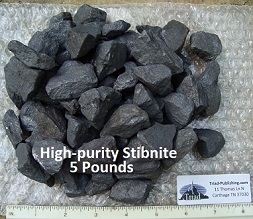
This high-grade ore was hand-selected at the Empresa Minera mine in Bolivia. Quality of Ore: 71% Antimony, 0.07% Lead, 0.08% Arsenic; this is incredibly rich ore, as the theoretical amount of antimony in Sb2S3 is 71.7%.
In 1993, Triad Laboratories (later Triad Publishing) acquired this ore directly from the owners of the mine in Bolivia and imported it to the USA for sale to researchers, most were members of The Philosophers of Nature (LPN-USA). Les Philosophes des la Nature in France made the same ore available to their members for research. Size of pieces will vary, however photos show typical sizes of mineral.
Triad-Publishing offers the discriminating student unique courses and video tapes on Alchemy, Qabala and the Western Esoteric Path with a focus on material developed by Jean Dubuis, perhaps the most revealing teacher of these subjects. Courses developed by Jean Dubuis include, Spagyrics, Mineral Alchemy, Qabala, Esoterics, and his masterpiece, The Experience of Eternity.
We offer a secure site for your orders; product typically ships within 24-48 hours.
In Loving Memory: Jean Dubuis
April 29, 1919 - April 6, 2010
Born in 1919 in Oise County, France, 40 km north of Paris, Jean Dubuis was unique in the circle of truth seekers: he was both a scientist and a genuine Adept, alchemist and qabalist.
Scientist, Jean Dubuis was employed as an electronics engineer. His college studies had been interrupted by the German occupation of France during WWII and circumstance allowed him to work for several months in the atomic synthesis laboratory run by Frédéric Joliot-Curie, the nephew of Marie Curie. After the French Liberation, his path lead him to work in radio-electricity companies, as they were called at that time. As Jean’s career evolved he became an IBM engineer where he worked for more than 30 years, involved with the evolution of computers, from tubes to transistors to integrated circuits.
Adept, Jean had an illuminating experience at the age of 8 at Mont Saint-Michel where the existence of the invisible world was revealed to him. Slowly, he acquired the conviction and knowledge that the invisible world is the foundation for the visible one. After this finding, Jean Dubuis incessantly tried to re-create his Mont Saint-Michel revelation by exploring texts of the Ancients and submitting these to experimentation. Symbolism, Qabalah and Alchemy are all “traditional: sciences that he studied and applied with a rigorous, free of prejudice method.
As a member of several esoteric philosophical groups, Jean first presented numerous lectures, forums and conferences on Qabalah, especially on the structure of Man and of the universe. Beginning in the early 60s, Jean began publishing articles on these topics in the newsletters of these groups in France and the U.S.A.
Jean strived to demonstrate in the laboratory the alchemical practice which he had previously studied theoretically. He succeeded and developed a plant alchemy course so others could have the opportunity to experiment. In order to spread this teaching in 1979 he created the “Les Philosophes de la Nature” an association that he presided over and animated for 12 years. The “Philosophes de la Nature” published and distributed to its members the teachings of Jean in the guise of monthly monographs that included theoretical and practical exercises. The Spagyric course was followed by a course on Mineral Alchemy. There were additional courses offered in Qabalah and General Esotericism.
In parallel to the activities of the French association, Jean Dubuis continued his contacts with the U.S.A. which in 1988 lead to the creation of the American association named “The Philosophers of Nature”. The lessons were translated into English and the association organized several largely attended seminars in the U.S.A. where Jean lectured and continued to share his knowledge.
After leading “Les Philosophes de la Nature” for 12 years, Jean transferred the management of the association to others in order pursue new research, particularly in the field of mind machines. Results were shared with some members who had assisted in the trial phase of those experiments. Several years later when Jean realized the spirit of Les Philosophes de la Nature had been compromised and the fraternity and tolerance that previously animated the association had been rapidly lost, he decided to dissolve it.
Jean Dubuis had never ceased to explore others paths that lead to “Initiation”. He had always maintained that the ultimate goal of Alchemy and Qabalah was progression on the Path that leads to “self-consciousness”. In that spirit, Initiation is the reconnection of conscious communications with upper levels of one’s Being. This is represented by those Sephiroth above the material level (Malkuth), up to the Tiphereth level that Jean called the “Inner Master”. Acknowledging these traditional Paths are lengthy, (and costly in the case of alchemy) he continued to develop a set of ideas and methods that allows access to a much faster progress by basing his teaching on a modified version of the Tree of the Sephiroth, presented in the graphic symbol that Jean called “Portae Lucis” and which is the supporting element to the meditation exercises offered in this new method of spiritual progress. This corpus was published into a new document called “Experimental Treatise – The Experience of Eternity” that was published both in French and English.
Jean Dubuis passed away two weeks short of his 91st birthday and spent his last moments working and researching efficient techniques( especially through magnetic, auditory and visual stimuli to the brain) that would induce mental states allowing one to develop consciousness and out of body experiences. Although unfinished, the progress had been very promising. He used to say: “I know this is a path of the future. I do not know if I will be the one who will conclude this business but I know some are on this path throughout the world. It will bring a tremendous social change when people realize there is life without the body and all major religions will collapse because people will have direct perceptions of the other worlds and will be able to judge based on knowledge, not faith”. Perhaps, as for all great men, it was his unfinished Work. Perhaps also his findings were too early for the planet.
Jean will be missed by all the people that came in contact with him. His incredible teachings as well as his personality, never judging others, never playing guru, always hinting or suggesting and never condemning other’s behaviors, place him in the very small circle of true initiates that throughout humanity’s history bore in secret the real title of Rose-Cross.
P.M, a friend and brother
A Masterpiece:
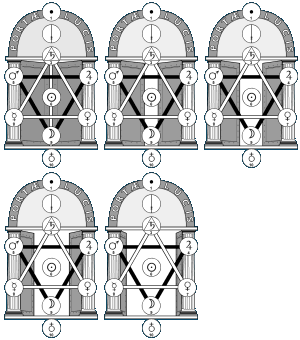
Jean Dubuis' final treatise, "The Experience of Eternity" is available on CD-ROM and as a printed book. This is the definitive work on the so-called "Portae Lucis method".
Store category "Alchemy & Spagyrics"